Thursday, August 29, 2019

She Would Be King by Wayetu Moore

She Would Be KingShe Would Be King by WayƩtu Moore
My rating: 4 of 5 stars

The settling of a new nation by free blacks, the illegal slave trade, and humans with supernatural gifts, all converge to form this fictional account of Liberia's founding during the early 1830s. Wayetu Moore's multifaceted story centers around 3 young adults who are each "gifted" with extraordinary abilities. Though from different places in the African diaspora, their destinies converge on the West African coast where they discover a plan to enslave Africans well after the international slave trade has been outlawed.

My favorite part of this book is how the author seamlessly weaves together the various strands of this story. Although the main setting is Liberia, some of the background stories take place in Jamaica and the United States. As a reader, I was not distracted by the movement from one setting to the other as I read the book. I also liked how Moore situated her main characters in fascinating individual stories; and how each of those stories helped to make the primary plot that much more interesting!

I am giving this book 4 stars. This story will definitely draw you in.


View all my reviews

Monday, August 12, 2019

Who Fears Death by Nnedi Okorafor


Who Fears DeathWho Fears Death by Nnedi Okorafor
My rating: 5 of 5 stars

I never thought I'd like Afro science fiction (or Afrofuturism), but boy was I wrong!!! Nnedi Okorafor's novel titled, Who Fears Death, is superb. The setting is a dystopian-future Sudan. The main character, Onyesonwu, is a child of rape perpetrated by an evil sorcerer. Onyesonwu's quest becomes to kill her biological father and to rewrite the "Great Book" which is the cause of turmoil among the region's people. The cast of characters who aid her on this quest (including camels) help to flesh out the story by revealing parts of the main characters personality, motives, strengths and weaknesses. Among themes explored in this work are gender, race, and religion.

My favorite part of this book is the author's portrayal of the intense love between Onyesonwu and her soulmate, Mwita. This serves to humanize an otherwise mystical character. It allows the reader to relate to her and to more easily imagine the sacrifices she must make to complete her quest.

My rating for this book is 5 out of 5 stars. The author's power of description are remarkable -- especially because she successfully describes occurrences and feelings that are completely fictional.
If you're looking for a read that is out-of-this-world, try this one.


View all my reviews

Saturday, June 1, 2019

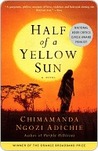
Half of a Yellow Sun by Chimamnda Ngozi Adichie


Half of a Yellow SunHalf of a Yellow Sun by Chimamanda Ngozi Adichie
My rating: 4 of 5 stars

Do you know that Nigeria had a Civil War? I suspect many people do not. Adichie's fictional dramatization of this conflict reminds us that "war is hell." The story is centered around a couple -- Olanna and Odinegbo-- and their servant, Ugwu. The couple, members of the post-colonial African intelligentsia, have studied abroad and adopted many accouterments of Western society. When war comes they join the secessionists who name their would-be republic Biafra. Socio-economic status does not shield Olanna and Odinegbo from the hardships of war. And the toll it takes on their relationship may be irreparable.

My favorite part of this book is how the author uses Ugwu's (the servant) point of view to tell much of the story. He is from the rural area; his perceptions of the couple act to alert the reader to the stark contrasts between the rural poor and urban elite. At times it seems that his indignation with Olanna and Odiegbo's deprivations during the war, is greater than their own.

I give this book 4 stars. As usual Adichie pulls the reader into this story with precise descriptions and relatable story lines.


View all my reviews


Friday, May 24, 2019

Behold the Dreamers by Imbolo Mbue

Behold the DreamersBehold the Dreamers by Imbolo Mbue


The immigrant genre is replete with stories of people who come to the United States looking for an elusive "better life." In this novel, Jende and Neni, a Cameroonian couple, come to Harlem hoping to find just that. Author Imbolo Mbue situates this novel during the financial crisis of the late 2000s. The couples' fortune begins well: Jende is hired as a driver for Edward Clark, a manager at Leyman brothers; and Neni, is using her visa to pursue a pharmacology degree. As a reader, I expected the story to end with Jende getting fired after the collapse of Leyman brothers. But there is a satisfying twist in the end that results in the couple getting an unexpected version of that "better life."

What I like most about the novel is the author's juxtaposition of the two male characters: Jende and Edward. Both men have high hopes for their sons and both are under a cloud of stress and expectation. Yet the power differential between them is great -- too great to ever breech. One could imagine that under different circumstances, they would be friends.

My rating for this book is 4 out of 5 stars. It is a fresh take on a familiar yet ever-relevant story.


View all my reviews

Wednesday, May 22, 2019

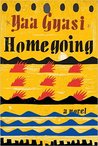
Homegoing by Yaa Gyasi


HomegoingHomegoing by Yaa Gyasi
My rating: 5 of 5 stars

Memorable sentence: "The whole landscape of the woman's body had transformed into a ruin; the young woman had been toppled, leaving this" (p. 440).

In this novel, Gyasi imagines the historical trajectory of two African sisters --named Effia and Esi-- born in the 1700s during the era of the Atlantic slave trade. Due to the circumstances of their birth, they never meet. The focus of each chapter alternates between the descendants of the sisters. Gyasi's initial setting is the Gold Coast of West Africa and her opening chapters detail how African and European slavers co-operated to produce slaves for the cruel Atlantic slave trade. The disruptions to African societies was drastic. Some peoples benefited, many were casualties.

My favorite part of this novel is how the author threads the metaphors of fire and water through her narrative. Effia was born during a fire; this impacts her descendants who all have a fear of fire. Esi, was enslaved and transported across the Atlantic ocean in a slave ship. The trauma of this journey impacts her descendants who all have a fear of water. The resolution in the final chapter is satisfying.
My rating for this book is 5 out of 5. Gyasi demonstrates the complexity of the relationships between the Europeans who lived on Cape Coast and the African societies who supplied them with captives. Particularly interesting is that of European men and their African "wenches." From these unions came a new, relatively privileged class of Africans.
View all my reviews