Friday, May 24, 2019

Behold the Dreamers by Imbolo Mbue

Behold the DreamersBehold the Dreamers by Imbolo Mbue


The immigrant genre is replete with stories of people who come to the United States looking for an elusive "better life." In this novel, Jende and Neni, a Cameroonian couple, come to Harlem hoping to find just that. Author Imbolo Mbue situates this novel during the financial crisis of the late 2000s. The couples' fortune begins well: Jende is hired as a driver for Edward Clark, a manager at Leyman brothers; and Neni, is using her visa to pursue a pharmacology degree. As a reader, I expected the story to end with Jende getting fired after the collapse of Leyman brothers. But there is a satisfying twist in the end that results in the couple getting an unexpected version of that "better life."

What I like most about the novel is the author's juxtaposition of the two male characters: Jende and Edward. Both men have high hopes for their sons and both are under a cloud of stress and expectation. Yet the power differential between them is great -- too great to ever breech. One could imagine that under different circumstances, they would be friends.

My rating for this book is 4 out of 5 stars. It is a fresh take on a familiar yet ever-relevant story.


View all my reviews

Wednesday, May 22, 2019

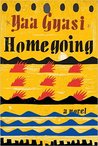
Homegoing by Yaa Gyasi


HomegoingHomegoing by Yaa Gyasi
My rating: 5 of 5 stars

Memorable sentence: "The whole landscape of the woman's body had transformed into a ruin; the young woman had been toppled, leaving this" (p. 440).

In this novel, Gyasi imagines the historical trajectory of two African sisters --named Effia and Esi-- born in the 1700s during the era of the Atlantic slave trade. Due to the circumstances of their birth, they never meet. The focus of each chapter alternates between the descendants of the sisters. Gyasi's initial setting is the Gold Coast of West Africa and her opening chapters detail how African and European slavers co-operated to produce slaves for the cruel Atlantic slave trade. The disruptions to African societies was drastic. Some peoples benefited, many were casualties.

My favorite part of this novel is how the author threads the metaphors of fire and water through her narrative. Effia was born during a fire; this impacts her descendants who all have a fear of fire. Esi, was enslaved and transported across the Atlantic ocean in a slave ship. The trauma of this journey impacts her descendants who all have a fear of water. The resolution in the final chapter is satisfying.
My rating for this book is 5 out of 5. Gyasi demonstrates the complexity of the relationships between the Europeans who lived on Cape Coast and the African societies who supplied them with captives. Particularly interesting is that of European men and their African "wenches." From these unions came a new, relatively privileged class of Africans.
View all my reviews